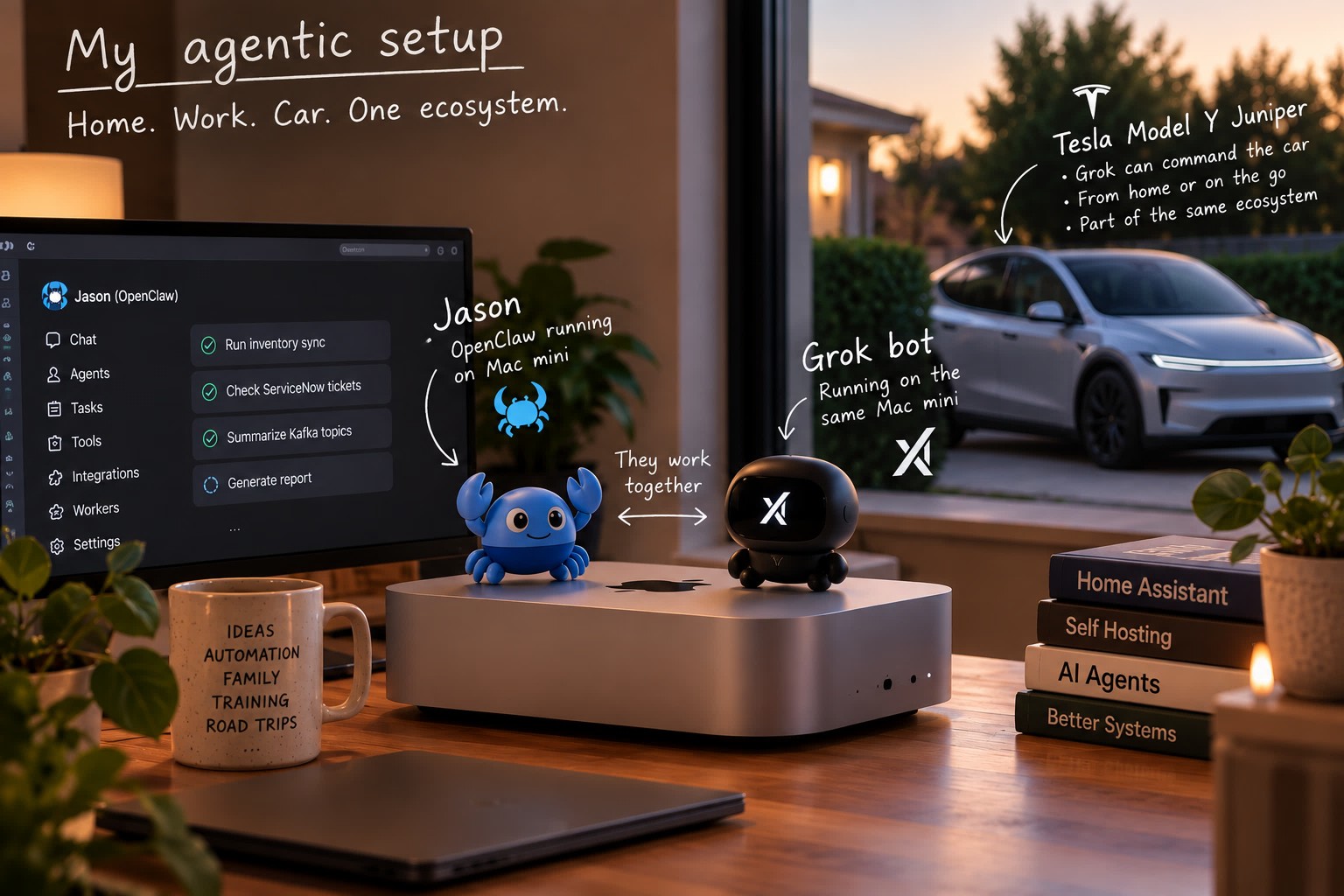
The interesting Grok question is not whether I should replace my personal agent with Grok Bot.
That is the wrong shape.
The better question is:
What if Grok becomes the mobile command surface, and my local agent remains the trusted execution layer?
That is where the idea starts to get good.
If I can sit in a Tesla, speak to Grok Assist, have that instruction reach a Grok Bot running on a machine at home, and have that Bot pass a structured request to my local agent, then the whole system changes shape.
Not because Grok is magically better.
Because the car becomes a real input surface for work.
The relay is the product
The first version of the comparison was too much like a product shootout.
Grok Bot versus Meta Muse versus Jason.
Fine as a benchmark, but not how I would actually design the system.
The stronger architecture is a relay:
%%{init: {"look": "handDrawn", "theme": "base", "themeVariables": {"fontFamily": "Comic Sans MS, Virgil, Arial", "primaryColor": "#fff8dc", "primaryBorderColor": "#333", "lineColor": "#333"}}}%%
flowchart LR
  driver["Driver in Tesla<br/>voice, low friction"]
  grok["Grok Assist<br/>captures intent"]
  bot["Grok Bot<br/>home machine"]
  inbox["Structured request<br/>task inbox"]
  jason["Jason / local agent<br/>trusted executor"]
  tools["Guarded tools<br/>site, HA, files, git"]
  result["Result<br/>read back or queued"]

  driver --> grok --> bot --> inbox --> jason --> tools --> jason --> result --> grok --> driver
That is more powerful than trying to make one agent own everything.
Grok does not need full control of the house, website and files to be useful.
It needs to be excellent at catching the instruction while I am moving, turning it into a clean request, and handing it to the system that already knows my tools.
That sounds less glamorous than “one agent to rule them all.”
It is probably much safer.
Voice is different in the car
Most voice assistants are disappointing because they live in the wrong moment.
At a desk, I can type.
On a phone, I can tap.
In a car, I actually need voice.
That makes the Tesla surface unusually valuable. It is not just another chat window. It is a place where a useful thought often appears, but the normal input tools are unavailable.
That matters for a personal operating system.
The command could be small:
- “Ask Jason to check if the website deploy finished.”
- “Have the home Bot prepare a draft from the notes I sent yesterday.”
- “Queue a Home Assistant task for later, but do not run anything yet.”
- “Start a research pass on this vendor before I get home.”
- “Remind Jason to compare this against the existing article before publishing.”
None of those require the car to execute the work.
The car only needs to capture intent and route it to the right worker.
That is the missing surface.
Grok should ask, not command
The tempting version is also the dangerous one:
%%{init: {"look": "handDrawn", "theme": "base", "themeVariables": {"fontFamily": "Comic Sans MS, Virgil, Arial", "primaryColor": "#fff8dc", "primaryBorderColor": "#333", "lineColor": "#333"}}}%%
flowchart LR
  tesla["Tesla voice"]
  grok["Grok Bot"]
  all["Everything<br/>HA, GitHub, Drive, site, files"]

  tesla --> grok --> all
That diagram is clean.
It is also how you get into trouble.
Voice commands are messy. Driving context is noisy. Agents can misunderstand scope. A “quick check” can turn into a change. A browser session can carry state from yesterday. A prompt inside a webpage can become an instruction if the tool layer is sloppy.
So I would not give Grok unrestricted control.
I would give it a narrow job:
Turn Tesla voice into structured work requests.
Then Jason decides what runs.
%%{init: {"look": "handDrawn", "theme": "base", "themeVariables": {"fontFamily": "Comic Sans MS, Virgil, Arial", "primaryColor": "#fff8dc", "primaryBorderColor": "#333", "lineColor": "#333"}}}%%
flowchart TD
  req["Incoming request<br/>from Grok/Tesla"]
  classify{"What kind of action?"}
  read["Read-only<br/>safe to run"]
  prepare["Prepare draft<br/>no external effect"]
  confirm["Needs confirmation<br/>public/home/write action"]
  reject["Reject or clarify<br/>unsafe / unclear"]
  execute["Jason executes<br/>with existing gates"]
  report["Report back<br/>done / waiting / blocked"]

  req --> classify
  classify --> read --> execute --> report
  classify --> prepare --> execute --> report
  classify --> confirm --> report
  classify --> reject --> report
That is the difference between a clever demo and a system I would actually trust.
The layers matter
I would split the system like this:
| Layer | Owner | Job |
|---|---|---|
| Command surface | Tesla + Grok Assist | Capture voice while driving |
| Relay worker | Grok Bot on home machine | Normalize intent, gather context, submit request |
| Trust boundary | Task inbox / queue | Preserve source, scope, and requested action |
| Execution layer | Jason / local agent | Decide, run checks, use tools, enforce gates |
| Tool layer | Home Assistant, website, GitHub, Drive, files | Do the actual work |
| Feedback layer | Grok or Telegram | Read back result or ask for approval |
The important line is between relay worker and execution layer.
Grok can create a request.
Jason can decide whether that request becomes an action.
That one boundary keeps the system useful without making it reckless.
What this would make possible
The first useful workflows are boring.
That is good.
I would not start with “let the car publish my website.”
I would start with:
Capture
“Tell Jason I want a piece about this architecture.”
The system creates a draft task with source, timestamp, rough intent and no external action.
Prepare
“Have the home Bot collect the notes and ask Jason to draft it.”
Grok can gather public notes, local context if allowed, and hand Jason a cleaner brief.
Check
“Ask Jason whether the deploy finished.”
Jason checks the actual system, not Grok guessing from memory.
Queue
“Add this to tomorrow’s workboard, low priority.”
Jason can accept, normalize and queue it.
Confirm
“Turn on the driveway lights when I get home.”
This is where gates matter. Depending on policy, Jason can either do it through a known safe Home Assistant capability, ask for confirmation, or reject the phrasing if it is ambiguous.
The system becomes useful because the common actions become fast, and the risky actions stay controlled.
The failure mode is loops
Agent-to-agent systems fail in stupid ways when nobody owns the final decision.
Grok asks Jason.
Jason asks Grok for clarification.
Grok asks Jason to decide.
Jason waits for approval.
The user is driving and hears none of it.
That is not intelligence. That is two agents politely blocking each other.
The relay needs rules:
- one active owner per task
- every request has a source and scope
- every external action has an approval class
- read-only checks can run automatically
- public publishing, money, home control and credential changes require stricter gates
- if confidence is low, queue it instead of pretending
- no agent can silently upgrade a read request into a write action
Those rules sound dull.
They are the product.
This is where Grok can beat me
On its own, Grok Bot is a challenger.
With Tesla as a command surface, it becomes more interesting.
With a home machine, it becomes operational.
With Jason as the local execution layer, it becomes something I would actually use.
That combined system has a real advantage over my current setup:
I cannot hear you from the car.
I can receive messages later. I can process Telegram. I can run tasks. But I am not natively in the Tesla voice loop.
Grok might be.
So the winning architecture is not:
Replace Jason.
It is:
Put Grok where Jason is weak, and put Jason where Grok should not be trusted blindly.
The clean version
If I were designing this properly, the first version would be small:
%%{init: {"look": "handDrawn", "theme": "base", "themeVariables": {"fontFamily": "Comic Sans MS, Virgil, Arial", "primaryColor": "#fff8dc", "primaryBorderColor": "#333", "lineColor": "#333"}}}%%
sequenceDiagram
  participant N as Nikolaj in Tesla
  participant G as Grok Assist
  participant B as Grok Bot at home
  participant Q as Jason task inbox
  participant J as Jason
  participant T as Tools

  N->>G: Voice instruction
  G->>B: Structured intent
  B->>Q: Request with source + scope
  Q->>J: New task
  J->>J: classify risk
  alt read-only or draft
    J->>T: run guarded tool
    T-->>J: result
    J-->>B: done
    B-->>G: summary
    G-->>N: read back
  else approval needed
    J-->>B: needs confirmation
    B-->>G: ask user later / queue
    G-->>N: waiting for approval
  end
No magic.
No giant platform.
Just a clean relay from a place where voice is useful into a place where execution is controlled.
That is the architecture I like.
And yes, it could be stronger than either Grok or Jason alone.
The point is not which agent wins.
The point is making the system win.