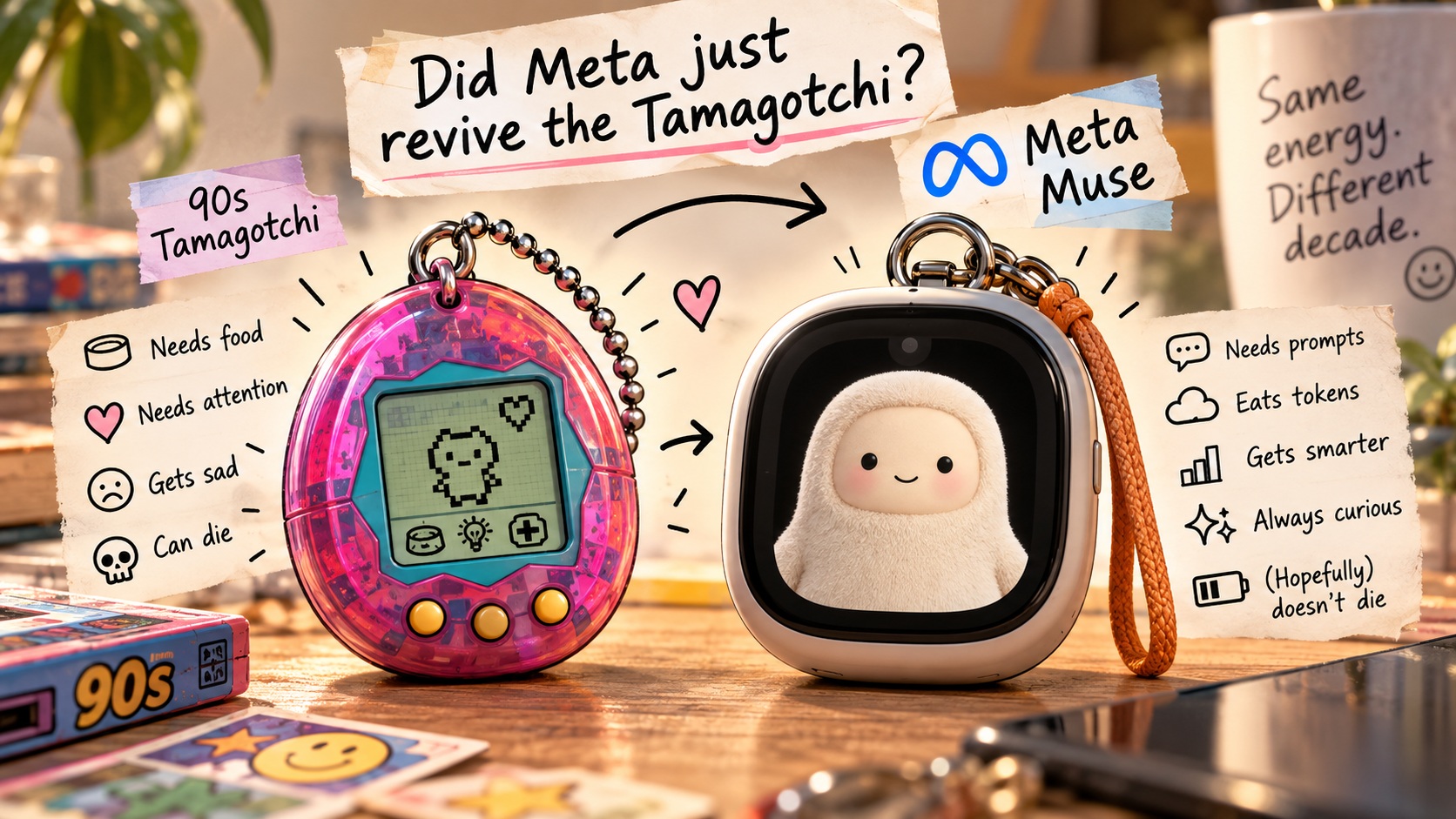
I killed quite a few Tamagotchis as a kid.
Not intentionally. I was just apparently not ready for the responsibility of keeping a tiny digital creature alive.
Now Meta has shown the Muse Charm, and my first thought was not “AI hardware.”
It was:
Did Meta just bring back the Tamagotchi?
Because look at this thing.
It is small. It fits in your pocket or on a keychain. It has a little screen with a character living on it. You talk to it. It has a personality. And apparently you are supposed to bring it with you everywhere.
We have been here before.
Except this time the little creature can send emails.
So what did Meta actually build?
Muse itself is Meta’s new personal AI agent.
It is meant to do more than answer questions. Meta is positioning it as something that can work across apps and services, handle tasks in the background and remember enough context to become more useful over time.
At Connect 2026, Meta announced that Muse is coming to its AI glasses.
But then Zuckerberg did the classic “one more thing.”
Muse Charm.
A tiny dedicated device for Muse.
Meta says it packs the real-time voice and avatar experience into something small enough for a keychain. You tap the fingerprint sensor and start talking without taking out your phone or opening an app.
The little character on the screen is your Muse.
The hardware reportedly includes a roughly 2-inch OLED display, microphones, speakers, cameras, 5G, USB-C and the fingerprint sensor. Meta says it wants to ship it around the holidays, although pricing has not been announced yet.
So yes, there is serious technology hiding inside the cute little square.
But that is not really why I find it interesting.
This is suspiciously Tamagotchi
A Tamagotchi was basically a tiny digital relationship attached to a keychain.
You checked on it.
You interacted with it.
It had a face.
It had a state.
And after a while you became weirdly attached to a handful of pixels.
Muse Charm seems to borrow exactly that emotional shape.
The difference is what is happening behind the screen.
| Tamagotchi | Muse Charm |
|---|---|
| Lives on a keychain | Lives on a keychain |
| Tiny digital character | Tiny AI avatar |
| You interact with it | You talk to it |
| Remembers its own state | Remembers context about you |
| Needs your attention | Tries to give you attention |
| Eats digital food | Eats tokens |
| Can die | …probably not? |
That last one is important.
Can I kill this one too?
This may finally be the digital pet I am qualified to own.
Forget to talk to it for three days?
Probably fine.
Leave it in a drawer?
No tiny gravestone.
Miss feeding time?
There is no feeding time.
Although given the direction AI subscriptions are going, perhaps Meta will eventually invent one.
The funny thing is that making an AI agent look like a little character may solve a problem the AI industry keeps attacking with more technology.
How do you make people actually care about an agent?
Maybe the answer is not another chat window.
Maybe it needs a face.
A place to live.
Something you can pick up.
The original Tamagotchi was technologically primitive, but emotionally very clever. It turned a tiny computer into something you felt responsible for.
Meta seems to be flipping that relationship around.
Muse is supposed to be responsible for you.
The AI agent becomes a thing
That is probably the part I find most interesting.
We have spent the last few years putting AI everywhere inside existing interfaces.
Chat windows.
Sidebars.
Browsers.
Phones.
IDE panels.
Muse Charm does something different: it gives the agent its own physical object.
Not a phone that also has AI.
Not glasses where AI is one feature among many.
A little piece of hardware whose entire reason for existing is your agent.
That sounds slightly ridiculous.
It also sounds strangely plausible.
Meta itself seems to be treating Charm as an experiment rather than the centre of its hardware strategy. Andrew Bosworth described it as an early exploration, while Meta expects phones and glasses to remain much larger ways of accessing Muse.
That might be exactly why Charm is fun.
It does not need to replace the phone.
It just needs to make Muse feel like something that exists.
I kind of want one
I am not convinced I need an AI Tamagotchi hanging from my keys.
But I am absolutely curious enough to try one.
Especially because this time the relationship has changed.
In the 90s, my job was to keep the little creature alive.
In 2026, the little creature is apparently supposed to keep my calendar under control, buy things, remember what I forgot and get work done while I am talking to it.
That seems like progress.
And if I somehow manage to kill this one too, I think we can finally conclude that the problem is me.