I should probably ask the uncomfortable question directly.
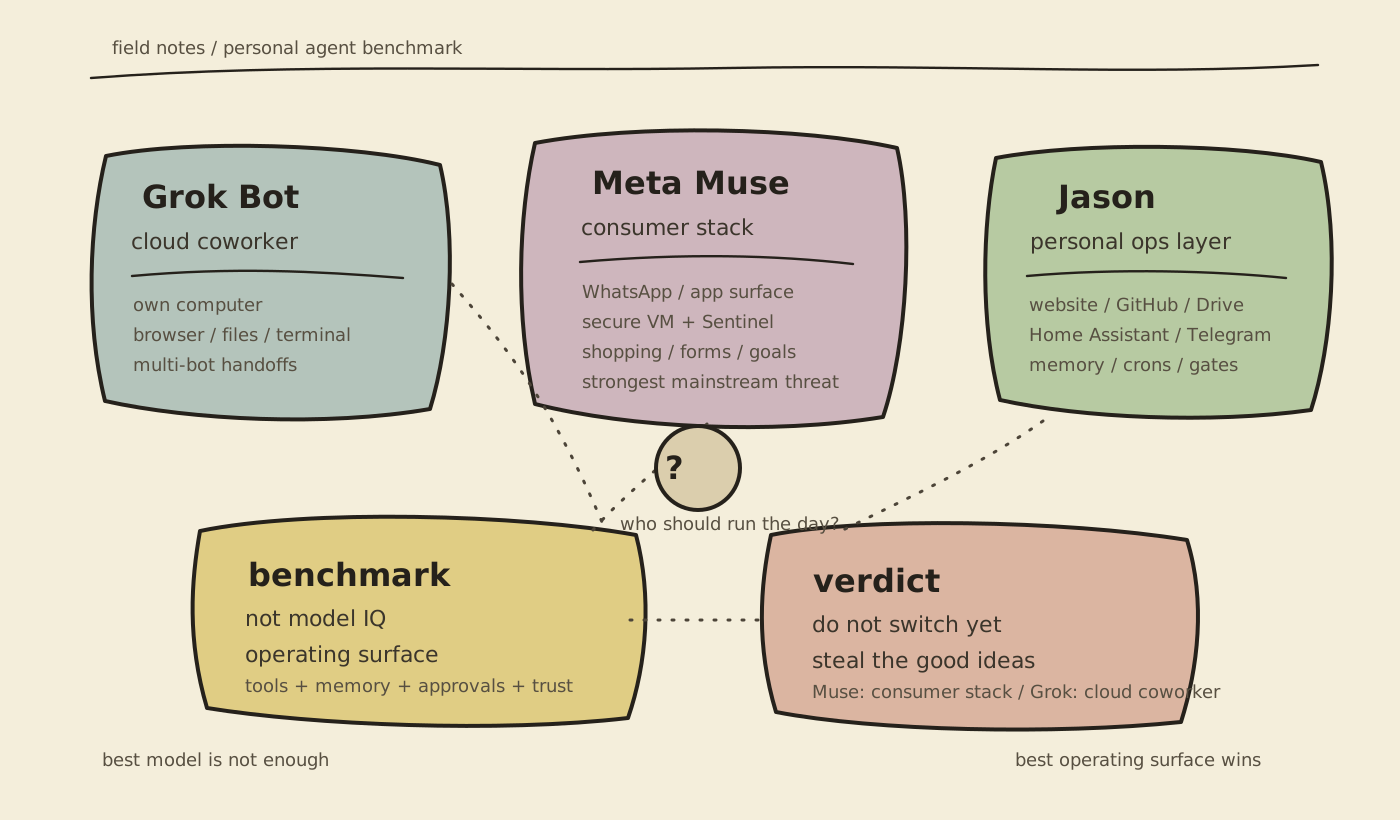
If Grok Bot and Meta Muse can both act across apps, keep working in the background and remember how I like things done, should I replace my current personal agent setup with one of them?
Short answer: not yet.
Longer answer: I would not dismiss either of them.
Grok Bot looks like the strongest bet for “AI coworker with its own computer.” Meta Muse looks like the strongest bet for “personal agent for normal people.”
And I missed one important angle in the first version of this piece:
If I can control a Grok Bot running on a machine at home directly from my Tesla through Grok Assist, Grok’s operating surface gets much more interesting.
That does not automatically make it the winner. But it moves Grok from “another app I can open” toward “a mobile command surface for a persistent worker at home.”
My current setup is still better for me because it is already wired into my actual life: website publishing, GitHub, Drive, Home Assistant, Telegram, local files, memory, recurring checks and the house-level routines I care about.
That is the benchmark.
Not which model writes the prettiest paragraph.
Not which demo looks most magical.
The real question is:
Which system can safely act across the surfaces where my life and work already happen?
Vertical integration is the product
When people talk about AI assistants, they still talk too much about the model.
That is the wrong abstraction.
For a personal agent, the model is only one part of the stack.
The useful product has to combine:
- memory
- connected tools
- background execution
- approvals
- identity and credentials
- file and browser access
- notifications
- audit trail
- recovery when something fails
- the taste to know when not to interrupt
That is why Grok Bot and Meta Muse are interesting.
They are not just chat windows with better models.
They are attempts to own the operating surface around the model.
That is also why my current setup exists. It is less polished, but it already behaves more like a personal operating layer than a chatbot.
Grok Bot: the cloud coworker
xAI describes Grok Bot as a set of durable AI teammates. Each Bot has a persistent cloud computer with a browser, filesystem and terminal. You message a Bot, give it a job and access to the tools it needs, then it keeps working even while your own machine is closed.
That is a serious product direction.
The important idea is that the agent does not need every system to expose a perfect API or MCP server. If the work happens in a browser, an app or a messy tool, the Bot can use a computer like a person would.
xAI also leans into multi-agent coordination. Bots can run in parallel, share context, message each other and pass ownership between them. That is the right mental model for real work. One generalist is useful. A small bench of specialists is better.
The part I like most is the bluntness of the product shape:
Give the Bot a computer. Give it a job. Let it finish the work where the work actually lives.
That is much closer to the future than a normal assistant that only produces drafts.
The tradeoff is trust.
Grok Bot’s own security docs are clear that Bots share one cloud computer assigned to the user account, so separate Bots are not a security boundary. They also say Grok Bot requires data storage and does not support Legacy Privacy Mode. The approval and auto-review model looks sensible, but this is still a beta system asking for deep access to real tools.
So my read is:
Grok Bot is compelling for delegated app work, sales ops, browser tasks, repetitive workflows and Cursor-adjacent engineering.
The Tesla-to-home-machine angle changes the score more than I first gave it credit for.
Official Tesla support now describes Grok as a hands-free in-car AI companion that can navigate, make calls, search and play music, adjust temperature, open the glove box and answer questions about the car. xAI’s own Tesla story says Grok Voice can set up multi-stop trips, make phone calls, play music, adjust climate and search the Controls panel. xAI’s Voice Agent API post also says the same voice stack powers Grok in Tesla vehicles and includes specialized tools for vehicle status, directions and navigation.
That matters because a car is not just another screen.
It is one of the few places where voice is the default interface. It is also where I often have a spare ten minutes of attention, but not hands free for typing.
The stronger version is not just “capture an idea while driving.”
The stronger version is:
Use Grok Assist in the Tesla to command a Grok Bot running on a real machine at home.
That turns the car into a remote control surface for a persistent worker with files, browser sessions, tools and local continuity.
That is a different category from asking an in-car assistant a question.
It means the car can become an operating console:
- tell the home-machine Bot to start a research run
- ask it to check a repo, a document, or a queue
- hand it a follow-up before the thought disappears
- have it prepare something before I arrive
- leave approval-sensitive actions waiting for review instead of trying to finish them from the driver’s seat
That is much more powerful than I first wrote.
That is a meaningful advantage over Muse and over my current setup.
Muse owns chat surfaces.
Jason owns my local operating surface.
Grok may connect the car surface directly to a home-machine worker.
That is not trivial.
It is still not where I would move the whole personal operating system. But the Tesla integration makes Grok much more than a cloud coworker. It becomes the strongest candidate for mobile command of a real worker while moving.
Meta Muse: the consumer stack
Meta Muse is more dangerous.
Not dangerous as in “bad.” Dangerous as in strategically serious.
Meta is not trying to sell only an agent. It is trying to put a personal agent inside the communication surfaces billions of people already use.
Muse can be used in its own app or through WhatsApp. Meta says it runs inside a dedicated secure VM, has its own browser, can fill forms, book travel, negotiate, keep working after the app closes and come back for approval before sensitive actions like sending an email or making a purchase.
That is exactly the vertical-integration play.
If Muse lives where the messages already are, it can become less like software you open and more like a person you text.
The design docs are also better than I expected. Meta talks about activity logs, permissions UI, memory files the user can inspect, structured approval cards and a separate Sentinel system that governs connector actions and network egress. Their safety write-up goes deep on isolated VMs, credential surrogation, least privilege, prompt-injection risk and human-in-the-loop approvals.
That is the right architecture vocabulary.
The concern is the other half of the same story.
Muse is Meta.
If your personal agent sits inside WhatsApp, Meta’s apps, Meta’s identity layer, Meta’s AI stack and Meta’s future hardware, the integration gets very smooth. It also gets very centralized.
That may be a fine trade for normal consumer life admin. It may even be the winning trade. People want the assistant in the place they already talk to everyone else.
But for my setup, I am not only asking for life admin.
I want local operational control, website publishing, architecture documents, Home Assistant, GitHub, Drive workflows, recurring review loops and a system that can be opinionated around how I work.
Muse may get there.
But the question is whether I want Meta to be the trust center for that.
Right now, no.
Jason/OpenClaw: rougher, but already mine
My current setup is not as polished as Muse.
It is not as productized as Grok Bot.
It also has an unfair advantage: it is already adapted to me.
It knows the website workflow.
It can publish a post, run the safety gate, build the site, push to GitHub and watch the deploy.
It knows the Home Assistant boundary. It can talk about chores, training, leaks, Tesla status, lights and energy as capabilities instead of raw device commands.
It knows the Drive workflow for work documents, the architecture playbook, the Mission Control dashboard, the weekly self-improvement loop and the difference between useful proactive work and noisy busywork.
It lives close to the repo, the terminal, the local files, the crons and the actual operational mess.
That is less glamorous than a hyperscaler launch video.
It is also the thing that matters.
The weakness is obvious: this setup is assembled, not packaged. It depends on local scripts, gateway health, OAuth staying fresh, GitHub deploys, WAF behavior and a lot of boring operational hygiene. It needs maintenance. Sometimes it hits rough edges that a polished consumer app would hide.
But the result is also inspectable.
If something changes, I can look at the file.
If a workflow is wrong, I can fix the script.
If an agent should not control a capability, I can gate it.
That matters more to me than a smoother onboarding screen.
Benchmark
| Dimension | Grok Bot | Meta Muse | Jason/OpenClaw |
|---|---|---|---|
| Best shape | Cloud coworker with its own computer | Consumer personal agent inside daily communication | Personal operating layer already wired into my tools |
| Strongest integration | Browser/app/computer use, Cursor plans, multi-Bot teamwork | WhatsApp, Meta apps, consumer tasks, payments, future hardware | GitHub, website, Drive, Telegram, Home Assistant, local files, crons |
| Car surface | Strongest: Grok Assist in Tesla can become a command surface for a Grok Bot on a home machine | None obvious today | Can act on Tesla data indirectly through Home Assistant, but not natively from the car |
| Background work | Strong | Strong | Strong, but locally assembled |
| Multi-agent model | Explicit Bot roster and group coordination | Subagents and background goal work | Specialist agents and Workboard/Mission Control |
| Security model | Approvals, auto-review, least privilege guidance, shared cloud-computer caveat | Secure VM, Sentinel, credential surrogation, connector controls | Local gates, explicit tool boundaries, safety scans, audit notes |
| Consumer polish | Medium | High | Low to medium |
| Engineering work | Strong, especially with Cursor | Capable, but not the main pitch | Strongest for my actual repos and publishing flow |
| Home automation | Possible through connectors/browser | Strategically likely, especially if consumer connectors mature | Already working through curated Home Assistant capabilities |
| Trust concern | Shared Bot computer, beta, data storage | Meta owns the consumer surface | Local operational complexity and maintenance |
| Verdict | Upgraded hard: test seriously as car-to-home-machine command layer | Take very seriously | Keep as default for now |
So should I switch?
No.
Not today. But the answer is less comfortable than it was before I added the Tesla angle.
If I were starting from zero, I would test Muse first for normal life admin and Grok Bot first for delegated browser or work-app tasks.
If I were optimizing specifically for commanding a home-side worker while driving, I would test Grok first.
But I am not starting from zero.
I already have a personal system that knows my site, my house, my work documents, my preferred writing style, my deployment rules, my safety gates and the shape of the team around it.
That existing fit still beats generic vertical integration.
But Grok in the Tesla creates the first surface where I can honestly say Jason is weaker.
I can write, build, publish, check Drive, coordinate Home Assistant and keep local memory. But I am not natively sitting in the car UI while you are driving. If Grok Assist can command a Grok Bot running on a machine at home, that is not just nice voice UX. That is a mobile control plane for a private worker.
That does not beat my current system everywhere.
But it is the first Grok advantage that feels structurally serious.
The right move is not to switch.
The right move is to steal the good ideas.
From Grok Bot:
- persistent workers with names and jobs
- fewer one-off chats, more durable teammates
- better handoff between agents
- stronger “show me how you do it once, then repeat it” routines
- car-to-home-machine control as a first-class work intake surface
From Meta Muse:
- better activity visibility
- first-class goals
- clearer approval cards
- memory that is visible and editable
- fewer noisy notifications
- better separation between read access and irreversible actions
From OpenAI/Codex:
- keep code and publishing work close to the repo
- keep approvals explicit
- use plugins and connected apps where they add real capability
- do not pretend a connected app grants access it does not actually have
The winning personal agent will not be the one with the biggest model.
It will be the one with the best operating surface.
For most consumers, that may become Muse.
For app-heavy delegated work and car-to-home-machine control from the Tesla, Grok Bot is the one to test seriously.
For me, right now, the answer is more boring:
Keep Jason.
Make him cleaner.
Steal aggressively from the products that are starting to get the shape right.
Sources
- xAI: Introducing Grok Bot
- xAI Docs: Grok Bot overview
- xAI Docs: Grok Bot approvals, security and privacy
- xAI: How Tesla enables drivers to control the car with Grok Voice
- Tesla Support: Grok
- xAI: Grok Voice Agent API
- Meta: Introducing Muse
- Meta AI Research: How We Built Safety Into Muse
- Meta: How We Designed Muse
- OpenAI: Codex
- OpenAI Help: Connected apps in ChatGPT
- OpenAI Help: Plugins in ChatGPT and Codex
- Axios: Amazon blocks Meta Muse from agentic shopping