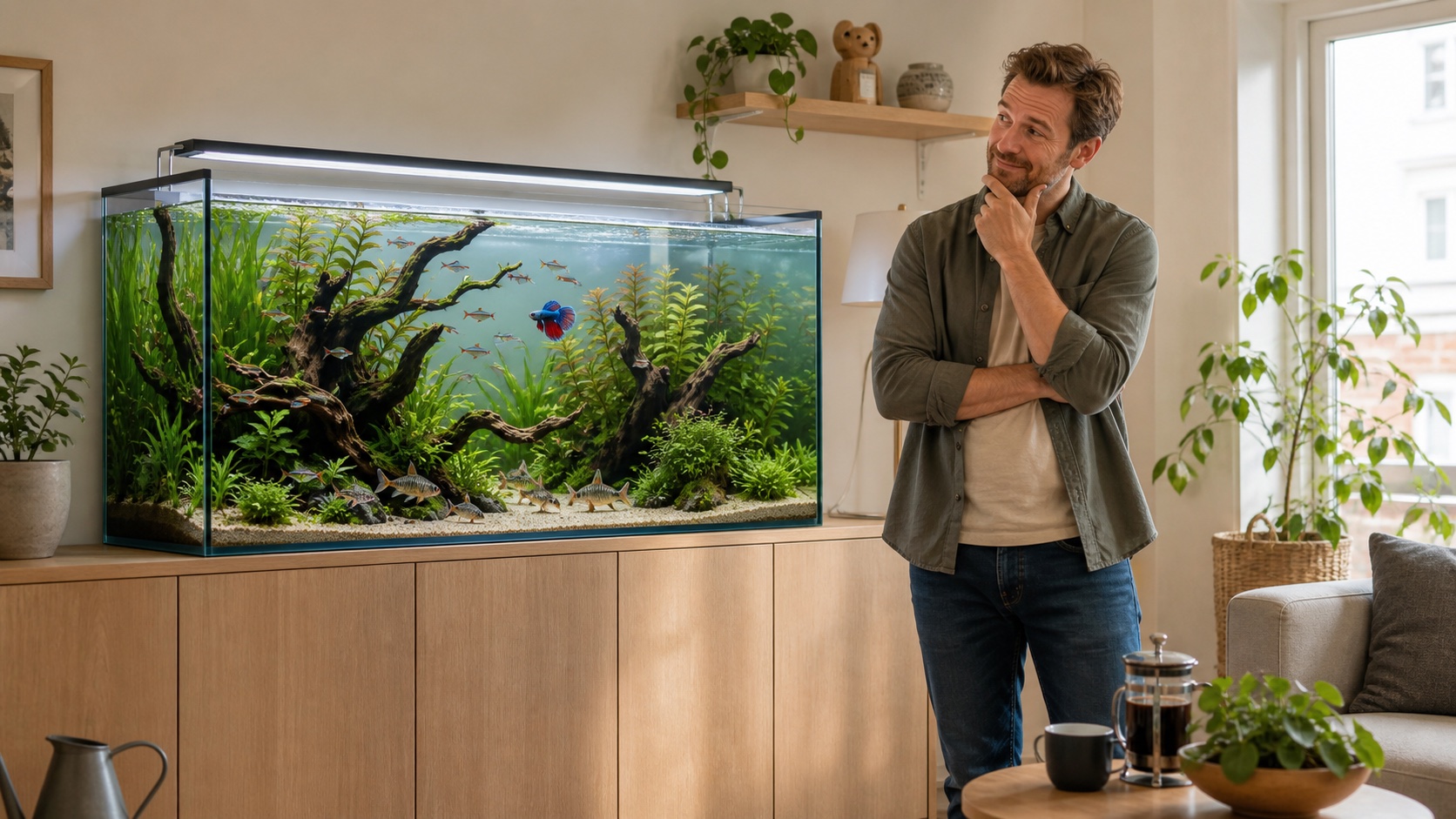
I have reached a dangerous stage of adulthood.
I am no longer just looking at furniture.
I am looking at furniture that contains water.
Specifically, I am looking at an Akvastabil Element 180 L with cabinet, which is how normal people say “nice aquarium” and how the universe says “congratulations, you are about to become a man who owns test strips.”
The question is obvious:
Am I now an aquarium guy?
Not a full aquarium guy yet. I do not have a branded towel. I have not said “water parameters” at dinner. I do not know anyone called Lars who breeds shrimp in a basement.
But I am close.
I have been researching freshwater tanks, saltwater tanks, bettas, community fish, plants, the nitrogen cycle, and the strangely emotional question of whether Janice can be convinced that the living room needs a professionally lit rectangle of wet responsibility.
The short answer:
Yes, this could be a very good idea.
The longer answer:
Only if I accept that the aquarium is not decoration with fish in it. It is a small ecosystem with a cabinet, electricity, bacteria, plants, animals, and one human who must not get bored after three weeks.
Annoying. But fair.
The tank itself: a very handsome gateway drug
The Akvastabil Element 180 L is not a tiny sad bowl. It is a proper aquarium: 100 x 40 x 48 cm, 180 litres, with LED light, heater, and internal filter included. The matching cabinet brings the total setup to living-room-furniture territory instead of “why is there a science project on the IKEA shelf?”
That matters.
One of the best arguments for this tank is that 180 litres is big enough to be forgiving. Small tanks go wrong quickly. Bigger water volume gives you more stability, more aquascaping options, and more room to build a proper freshwater community instead of running an aquatic bedsit with one angry fish and a plastic castle.
The setup is also plug-and-play-ish: light, filter, heater, cabinet. That does not mean “add fish immediately.” It means “you have fewer equipment excuses when you inevitably become the kind of person who researches driftwood at 23:17.”
Pros
- It is big enough to create a stable freshwater ecosystem.
- It looks like intentional furniture, not a panic purchase.
- It includes the boring essentials: light, filter, heater.
- 180 litres gives room for plants, hardscape, schooling fish, bottom dwellers, and a centerpiece fish.
- A planted tank can become genuinely calming, almost like a fireplace that occasionally judges you.
- It is a hobby the kids can observe without anyone needing another screen.
Cons
- Water is heavy. The filled setup is not “just 180 L.” It is water, glass, substrate, rocks, wood, cabinet, equipment, and your dignity if it leaks.
- The first month is not fish time. It is bacteria time. Extremely unfair branding.
- Algae will happen because nature is petty.
- You need maintenance discipline: water changes, testing, trimming plants, cleaning filter media properly.
- The upfront cost is not only the tank. You still need substrate, plants, hardscape, test kit, conditioner, food, net, siphon, timer, and probably the exact root you suddenly believe has character.
- If I overstock it because every fish in the shop looks like a tiny Pixar character, I deserve the consequences.
Freshwater first. Saltwater later, if I become unbearable
Freshwater is the right starting point.
Saltwater is not impossible. Plenty of people run beautiful marine tanks. But as a first family aquarium, saltwater adds extra systems and failure modes: salinity, marine salt, often reverse-osmosis water, stronger circulation, possibly protein skimming, more expensive livestock, more sensitive corals and invertebrates if you go reef, and a maintenance vocabulary that sounds like a plumber joined a chemistry cult.
Freshwater is already enough responsibility.
It still has biology, chemistry, equipment, and living animals. It still requires patience. But the learning curve is less punishing, the fish are generally cheaper, plants are rewarding, and a 180 L freshwater tank can look incredible without needing to recreate a coral reef in the corner of the living room.
Freshwater is the sensible on-ramp.
Saltwater is the “I now own a refractometer and have opinions about flow” era.
We are not there.
Yet.
The first law: cycle the tank before buying the citizens
This is the part every impatient beginner wants to skip.
Do not.
Fish produce waste. Waste becomes ammonia. Ammonia is dangerous. Beneficial bacteria grow in the filter and surfaces of the aquarium and convert ammonia into nitrite, then nitrate. Nitrate is less dramatic, but still managed through plants and water changes.
That is the nitrogen cycle.
It is not optional. It is the biological operating system of the aquarium.
So the first month should look something like this:
- Set up tank, cabinet, substrate, hardscape, plants, heater, filter, and light timer.
- Add dechlorinated water.
- Start the filter and heater.
- Add an ammonia source or use a beginner cycling method recommended by a good aquarium shop.
- Test ammonia, nitrite, and nitrate.
- Wait until the tank can process waste reliably.
- Add fish slowly, not like a man loading a shopping basket before closing time.
The aquarium hobby is secretly a patience test with plants.
What fish should live there?
For 180 litres, I would build the tank around peaceful freshwater layers:
- A school in the middle.
- A group on the bottom.
- Plants and clean-up crew support.
- One showy centerpiece fish if the temperament works.
The goal is not “many fish.”
The goal is a tank that feels alive without becoming a tiny underwater metro at rush hour.
Option A: the betta monarchy
A betta could work beautifully in a planted 180 L tank, but only if we treat the betta as a moody little monarch and design around him.
Male bettas are stunning. They are also individuals. Some are calm. Some wake up and choose litigation.
The betta version:
- 1 male betta as centerpiece
- 15-25 small peaceful schooling fish, such as harlequin rasboras, ember tetras, or other calm midwater fish
- 8-12 corydoras on the bottom, depending on species and final stocking
- Nerite snails for algae support
- Maybe Amano shrimp, but only if the betta does not decide they are premium snacks
- Dense plants, floating plant cover, driftwood, resting leaves, and gentle filter flow
What to avoid with a betta:
- Fin nippers.
- Flashy long-finned tank mates.
- Strong current.
- Other bettas.
- Tiny shrimp if the betta is a tiny crime lord.
This setup can be excellent because the tank is large enough to give everyone space. But the betta gets veto power. If he is aggressive, he may need a different setup.
In other words: the betta is not a fish. The betta is a hiring decision.
Option B: the peaceful community tank
This is probably the safer first aquarium.
No royal centerpiece with an ego. Just a calm, balanced freshwater community:
- 20-30 harlequin rasboras, cardinal tetras, rummynose tetras, or ember tetras
- 10-12 corydoras as the bottom crew
- 1 pair of honey gouramis or another peaceful centerpiece species
- Nerite snails
- Amano shrimp after the tank matures
- Lots of live plants
This gives movement, color, layers, and fewer fish-politics headaches.
It also looks more natural. A big school moving through plants is underrated. It feels like watching a tiny piece of river logic instead of a fish collection.
Option C: the planted ecosystem nerd tank
This is where things become suspiciously tasteful.
Think:
- Dark substrate
- Driftwood
- Java fern, Anubias, Cryptocoryne, Vallisneria, floating plants
- A large school of small fish
- Corydoras
- Shrimp and snails once stable
- Maybe no centerpiece at all
This is not “look at my one dramatic fish.”
This is “look at my balanced ecosystem, Janice.”
Dangerous sentence.
But compelling.
My first stocking plan
If this were my tank, I would start conservative:
Phase 1: Plants and patience
No fish. Just plants, filter, heater, cycling, testing, and me pretending that waiting is a personality trait.
Phase 2: first school
Add one group of hardy peaceful schooling fish. Let the tank adjust.
Phase 3: bottom crew
Add corydoras only once the tank is stable and the substrate is suitable for them.
Phase 4: centerpiece
Then decide: betta, honey gouramis, or no centerpiece.
This is the boring answer.
The boring answer is usually how fewer fish die.
What we need besides the aquarium
The shopping list nobody puts in the fantasy:
- Liquid test kit for ammonia, nitrite, nitrate, pH
- Water conditioner
- Siphon and bucket for water changes
- Thermometer
- Timer for the light
- Substrate
- Hardscape: driftwood and/or rocks
- Live plants
- Fish food, but not six types on day one
- Algae scraper
- Net
- Possibly extra filter media
- Possibly a quarantine tank later, if we become proper people
The key is to spend money on stability before buying fish.
Fish are not the first purchase.
Fish are the reward for not being an idiot with water.
How to convince Janice
Do not lead with:
“I found an aquarium.”
That sounds like a problem.
Lead with:
“I found a calm living-room project that replaces some screen time, looks beautiful, teaches the kids about ecosystems, and gives us a small ritual we can build together.”
That sounds almost responsible.
The Janice case:
- It is furniture with life in it. The cabinet makes it part of the room, not a hobby object squatting in the corner.
- It is calming. A planted aquarium is basically a moving painting that does not ask which streaming service to open.
- It is educational. The kids can learn about ecosystems, patience, water chemistry, plants, and animal care.
- It is not a puppy. Important distinction. Fish do not need walks in February.
- It has rules. We start freshwater, cycle first, stock slowly, and keep maintenance scheduled.
- It is not allowed to become ugly. No plastic skulls unless democracy collapses.
- It is a shared home upgrade. Not “my fish tank.” Our calm little underwater corner.
The strongest argument is not that it is fun.
It is that it can be beautiful, slow, and good for the room.
The weakest argument is “I promise it will be easy.”
Do not say that.
Say:
“It will take a bit of care, but I want to do it properly.”
That is the adult sentence.
Terrible, but effective.
The verdict
Yes.
I might be an aquarium guy now.
But the good version.
Not the version who impulse-buys six incompatible fish because they looked nice under shop lights. Not the version who turns the living room into a marine biology annex. Not the version who says “just one more tank” and means it in the same way people mean “quick IKEA trip.”
The good version starts with one proper 180 L freshwater tank, lots of plants, careful cycling, peaceful fish, and a maintenance routine that does not depend on enthusiasm lasting forever.
The aquarium should not be a decoration.
It should be a small living system we earn the right to keep.
Also, it would look ridiculously good.
Which is, unfortunately, a serious argument.
Sources I checked
- AkvaStabil Element 180 L official product page
- Unimati listing for the Akvastabil Element 180 L set with cabinet
- AkvarieButikken listing with dimensions and included equipment
- Aquarium Co-Op guide to the nitrogen cycle
- Fishkeeping guide to fishless cycling
- Buce Plant betta care guide
- PetSmart freshwater vs saltwater beginner overview
- Tropical Fish Hobbyist guide to moving from freshwater to marine aquariums