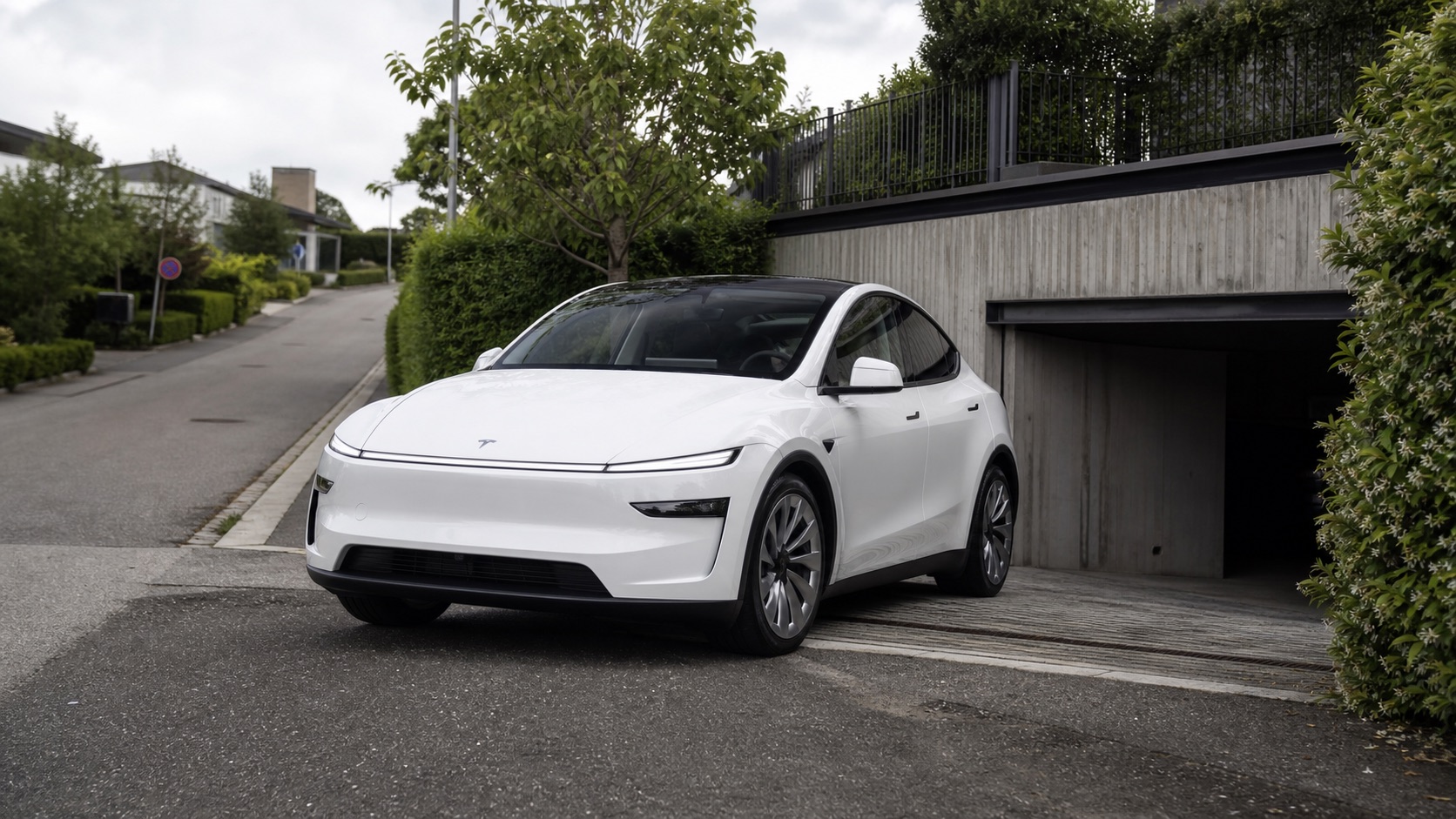
FSD Supervised is finally approved in Denmark.
Not “coming soon.” Not “waiting for Europe.” Not “maybe after another committee meeting.”
Actually available. Actually usable. Actually something you can try in Danish traffic.
That is a weirdly large shift.
I wrote earlier that the Dutch approval made Denmark feel more plausible, but still not imminent: Tesla FSD Supervised is finally approved in the Netherlands. Denmark may not be far behind.
That post aged faster than expected.
On 9 June 2026, Færdselsstyrelsen confirmed that FSD Supervised is provisionally approved in Denmark. Tesla followed with the public rollout message on X:
Tesla Europe announcement on X
The legal part still matters: this is FSD Supervised. The driver is responsible. You still have to watch the road. You still have to be ready to take over. Færdselsstyrelsen is very clear on that point, and Tesla says the same in its Danish support page for the 30-day trial.
But after more than 200 km with it in Denmark, the interesting part is not the marketing name.
The interesting part is how quickly it stops feeling like a headline and starts feeling like infrastructure.
It works in the messy places
My first proper test was not a clean demo route.
It was heavy Copenhagen Friday traffic, motorway, country roads, ordinary Danish intersections, awkward lane choices, roundabouts, speed changes, cyclists, impatient humans, and all the boring edge cases that make European driving different from glossy launch videos.
And honestly, it was good.
Not perfect. Not magic. Not something you should blindly trust.
Good.
That distinction matters. The system still needs supervision, but it is no longer just doing the easy parts. It handles a lot of the normal driving stack in a way that feels coherent:
- it keeps pace without constantly feeling nervous
- it changes lanes with more confidence than older Autopilot behavior
- it reads a lot of road context without needing the road to be American-suburb simple
- it feels much less like a lane-keeping assistant and more like a driver-assistance layer that understands intent
The best compliment I can give it is also the least dramatic one:
After a while, I stopped testing it and started using it.
The carport test is where it got personal
There is one very specific test I care about more than any YouTube-style benchmark.
My carport.
It has a heavy incline. It is awkward enough that a generic “can it drive on a road?” test does not really cover it. This is the kind of local, stupid, private little challenge that actually decides whether a feature becomes useful in real life.
At first, I expected that to be too much.
But it has learned the routine, or at least it feels that way from the driver’s seat. It can now back out and get itself ready for me to take over and drive it up.
That sounds small.
It is not.
That is exactly where technology becomes real: not when it performs well in a polished scenario, but when it starts handling the annoying repeatable thing in your own life.
I am not saying the car has developed a personal memory of my driveway in some sci-fi sense. I am saying the experience feels adaptive. The system behaves less like a fixed demo and more like a product that is finding its way through actual local conditions.
That is the line it crossed for me.
Denmark is a useful test case
Denmark is not the hardest driving environment in the world, but it is not a trivial one either.
You get:
- narrow local roads
- cyclists everywhere in cities
- roundabouts
- wet surfaces and low winter light for much of the year
- country roads where lane markings and road edges are not always friendly
- motorway driving that is fast enough to punish hesitation
- city traffic that mixes cars, bikes, buses, pedestrians, vans, and people doing whatever people do on a Friday afternoon
That makes Denmark a good test market for FSD Supervised.
If it only worked on clean motorway stretches, I would be underwhelmed.
The surprise is that it feels useful across a much wider set of situations. Copenhagen traffic, motorway, and country roads are not the same problem. The system does not solve all of them equally, but it is good enough in enough places that the value is obvious.
The regulatory detail still matters
The approval is not a permanent EU-wide blank cheque.
Færdselsstyrelsen accepted the Dutch provisional approval from RDW, which means FSD Supervised can be used in Denmark for now. The bigger EU process is still pending. If the EU Commission later rejects the system, the provisional basis can disappear.
So the grown-up version is:
FSD Supervised is approved in Denmark, but it is still provisional and still supervised.
That sentence is less exciting than the Tesla fan version.
It is also the accurate one.
And it is enough.
Because the real change is not that Denmark suddenly has autonomous cars. It does not.
The real change is that advanced driver assistance has moved from regulatory theory into normal Danish roads. That creates a feedback loop: more drivers, more real usage, more scrutiny, more confidence or more criticism based on actual experience instead of forum arguments.
That is healthier than hype.
It feels like the start of a new driving habit
The strangest part is how quickly the mental model changes.
Before approval, FSD in Denmark was a timeline question:
When will it arrive? Will EU regulators allow it? Will Denmark be included? Will it be crippled compared with the US version?
After using it, the questions become much more practical:
When do I want to use it? Where does it make me calmer? Where do I still prefer to drive myself? How does it behave on the routes I actually take? What do I trust it with, and what do I not trust it with yet?
That is the better conversation.
Not “is Tesla saving the world?” Not “is this fake self-driving?”
More like:
Is this useful enough, supervised correctly, to become part of normal driving?
After 200+ km, my answer is yes.
With supervision. With judgment. With eyes on the road.
But yes.
That is not just a theoretical yes either. We are now seriously thinking about replacing our second car with a Model 3 with the FSD package on it. That is probably the clearest signal I can give. A feature has crossed a line when it changes what car you would actually buy next, not just what feature list you would argue about online.
The bottom line
FSD Supervised in Denmark feels like one of those moments where the future arrives in a boring shape.
No fireworks. No robotaxi. No legal miracle.
Just a car handling Copenhagen traffic, motorway driving, country roads, and an annoying steep carport better than I expected.
That is more interesting than the hype.
Because if this keeps improving from here, the change will not feel like one big dramatic switch.
It will feel like this:
You drive 200 km. You intervene sometimes. You stay responsible. You notice the system is getting useful.
Then one day, you realise the argument has moved on.
Sources
- Færdselsstyrelsen: Teslas førerassistentsystem FSD Supervised er foreløbigt godkendt i Danmark
- Tesla Denmark: Prøveperiode på Full Self-Driving (Supervised)
- Tesla Europe announcement on X
Hero image generated for this post. It is not a Tesla press image.