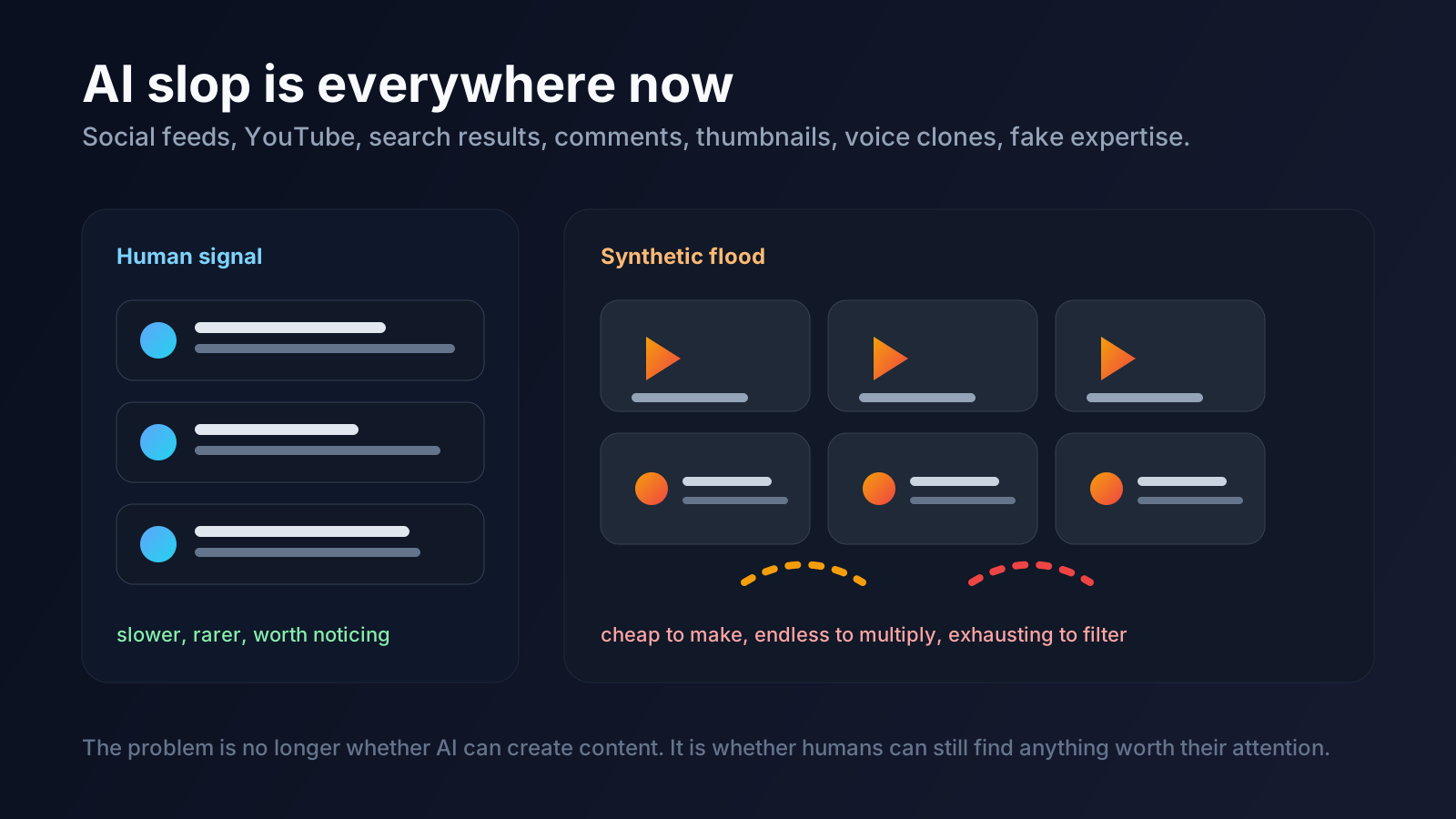
AI slop is not coming.
It is here already, and it is all over the place.
You see it in social feeds. You see it in YouTube thumbnails and faceless channels. You see it in recycled carousels, fake thought leadership, synthetic voiceovers, comment bait, fake summaries, fake experts, fake tutorials, fake product reviews, fake outrage, fake inspiration, and fake sincerity.
The weird part is that none of this is surprising anymore.
That is how you know it is getting bad.
We are moving from a content internet to a volume internet
For a long time, the internet rewarded people who could make something worth reading, watching, or sharing.
Now it increasingly rewards people who can generate the most output, hit the algorithm hardest, and dress up low-effort junk to look like signal for three seconds.
That shift matters.
Because AI does not just make content creation cheaper. It makes content pollution cheaper.
And once the cost of flooding the zone drops close to zero, every platform starts filling with the same thing:
- generic posts rewritten from other generic posts
- videos assembled from scripts no one actually believes
- voiceovers from people who never existed
- listicles built from summaries of summaries
- “educational” clips made by people who clearly do not understand the topic
- fake consensus generated by repetition
It is not just low quality.
It is low-cost mimicry at industrial scale.
Social media was always noisy. AI makes the noise endless
Social platforms were already full of performance, copying, and shallow takes.
AI did not invent that.
What it did was remove the remaining friction.
Before, if you wanted to flood LinkedIn, Instagram, TikTok, X, Facebook, or YouTube, you still needed some time, some effort, or at least some tolerance for your own bullshit.
Now you can manufacture tone, structure, thumbnails, scripts, captions, hashtags, repurposed clips, and fake authority in one sitting.
That changes the economics completely.
The problem is not that one person somewhere is using AI to draft a decent post.
The problem is that the platforms now reward the people willing to produce infinite sludge with just enough surface polish to trick the feed into giving it oxygen.
And once that loop works, it multiplies.
YouTube is becoming one of the clearest examples
You can see it everywhere now.
Channels with synthetic voices reading bland scripts over stock footage. Channels explaining topics they clearly do not understand. Channels mass-producing “documentaries” that are really stitched-together summaries of other people’s work. Channels with thumbnails engineered to feel important, while the actual content is empty by minute two.
Some of it is harmless filler. A lot of it is not.
Because YouTube does not just entertain people. It teaches them.
When slop gets dressed up as explanation, it starts replacing understanding with familiarity. People feel informed because they consumed something that looked structured and sounded confident.
That is a dangerous combination. Especially when the source material was generated, paraphrased, simplified, and optimized for retention before anyone asked whether it was actually true.
Search is getting worse too
This is the part that should worry more people.
Search used to be one of the internet’s great filtering systems. Imperfect, obviously, but still useful.
Now search increasingly has to index a web that is filling up with AI-generated filler pages, SEO sludge, fake comparison articles, fake reviews, parasite sites, and answer-shaped content designed to capture traffic instead of help anyone.
That means two bad things happen at once.
First, the amount of junk rises. Second, the cost of finding something written by a real person with actual knowledge goes up.
That is a terrible trade.
The internet gets larger while becoming less useful.
The real damage is not just aesthetic
People talk about AI slop like it is just annoying.
It is annoying, sure.
But the actual damage is deeper than that.
Slop changes trust. Slop changes attention. Slop changes what gets rewarded. Slop changes how hard it is to find real expertise.
When the internet fills with synthetic filler, people do not just consume more bad content. They start doubting everything.
That is the real tax.
Not just lower quality, but higher uncertainty.
You read a thread and wonder if the person wrote it. You hear a voice and wonder if it is real. You find a tutorial and wonder if the author ever tested it. You read a product review and wonder if anyone actually touched the product.
That constant uncertainty makes the whole environment worse.
It turns the internet into a place where confidence is cheap, volume is cheap, and verification becomes your problem.
The platforms are structurally bad at handling this
This is where the situation gets more brutal.
Most platforms are not built to reward truth, effort, or originality cleanly enough to stop this.
They are built to reward engagement, production, click-through, watch time, and recurrence.
So if AI makes it easier to produce content that looks good enough to generate those metrics, the platforms will absorb it whether they admit it or not.
That means “the market will sort it out” is not a serious answer.
The market may sort it out eventually, but only after users are already exhausted, trust is damaged, and every serious creator has spent months competing against industrialized junk.
That is not a healthy correction. That is a slow degradation curve.
Not all AI-assisted content is slop
This part matters.
Using AI does not automatically make something worthless.
People use AI well all the time. To draft, summarize, clean up, translate, structure, or speed up the boring parts of creating something real.
That is fine.
The problem is not assistance. The problem is substitution.
If AI helps a person say something they actually mean, good. If AI replaces having something to say in the first place, you get slop.
That is the line.
And right now, a lot of the internet is sprinting in the wrong direction.
What happens next
I think we are heading toward a pretty obvious split.
On one side, a growing ocean of cheap synthetic content built to satisfy algorithms. On the other, smaller pockets of work people still trust because it sounds human, feels specific, and carries real point of view.
That probably means a few things.
- human taste becomes more valuable
- credibility becomes more valuable
- direct trust matters more than platform scale
- people start looking for signals of realness on purpose
- smaller, sharper creators may end up beating larger synthetic farms in long-term trust
The irony is that AI may make human work feel more valuable again, not less.
But that does not happen automatically.
It only happens if people get tired enough of the junk to start choosing signal over volume.
The blunt version
AI slop is already everywhere.
It is on social media. It is on YouTube. It is in search. It is in comments. It is in newsletters. It is in fake educational content. It is in fake personal branding. It is in fake expertise dressed up as helpfulness.
And the problem is not just that it is bad.
The problem is that it is cheap, fast, and algorithmically compatible.
That combination scales.
So the real question is no longer whether AI can make content.
Obviously it can.
The real question is whether the internet can remain worth using once synthetic volume starts outcompeting human signal by default.
That is the fight now.
And honestly, most platforms do not look ready for it.
Cover image prompt
If you want to regenerate or replace the visual later, use this:
Editorial illustration for an article about AI slop flooding the internet, dark high-end interface aesthetic, split composition between rare human signal and overwhelming synthetic content, social feed cards, video tiles, search-style content blocks, subtle warning colors, modern product-design feel, no cheesy robots, no text, landscape format